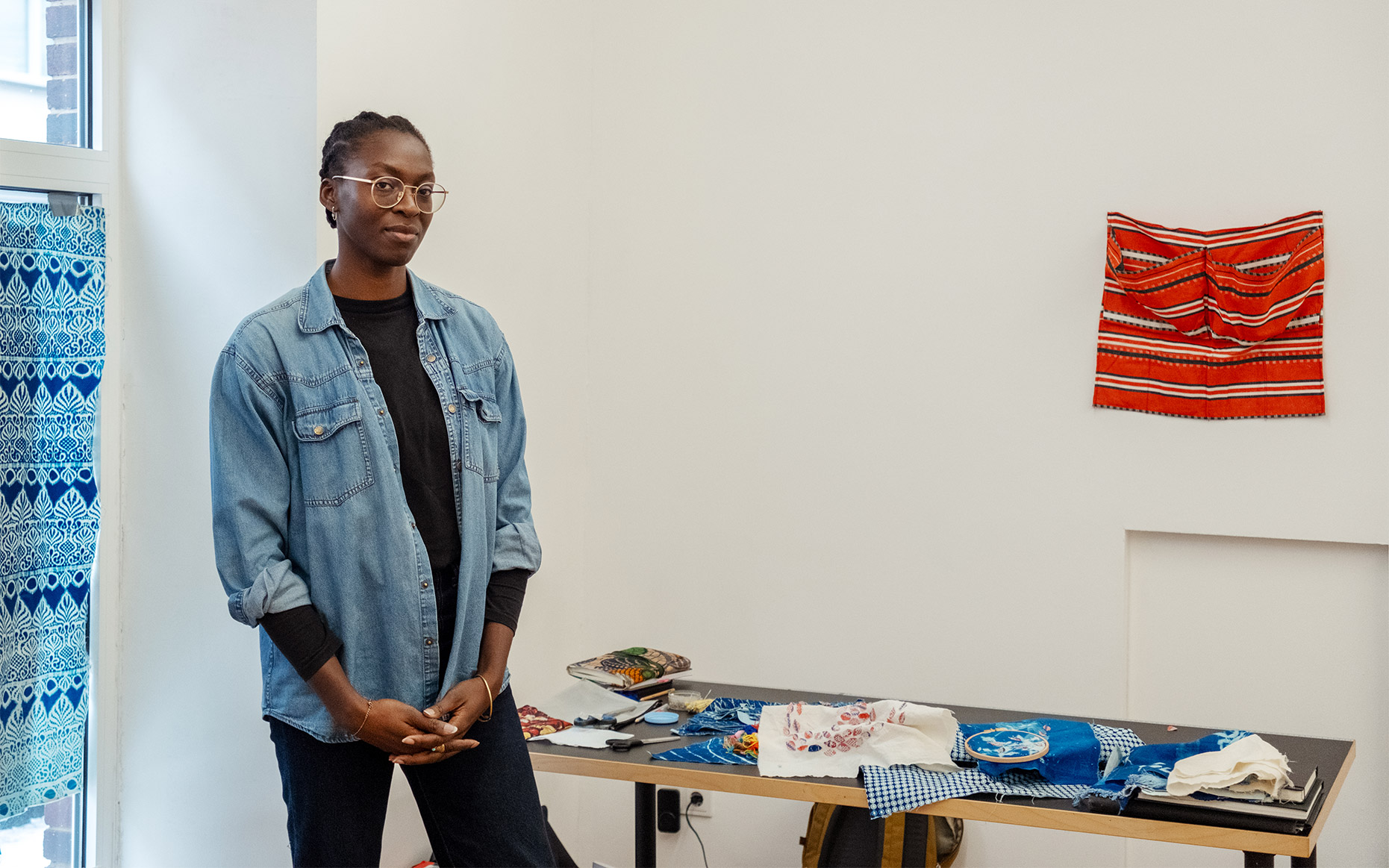
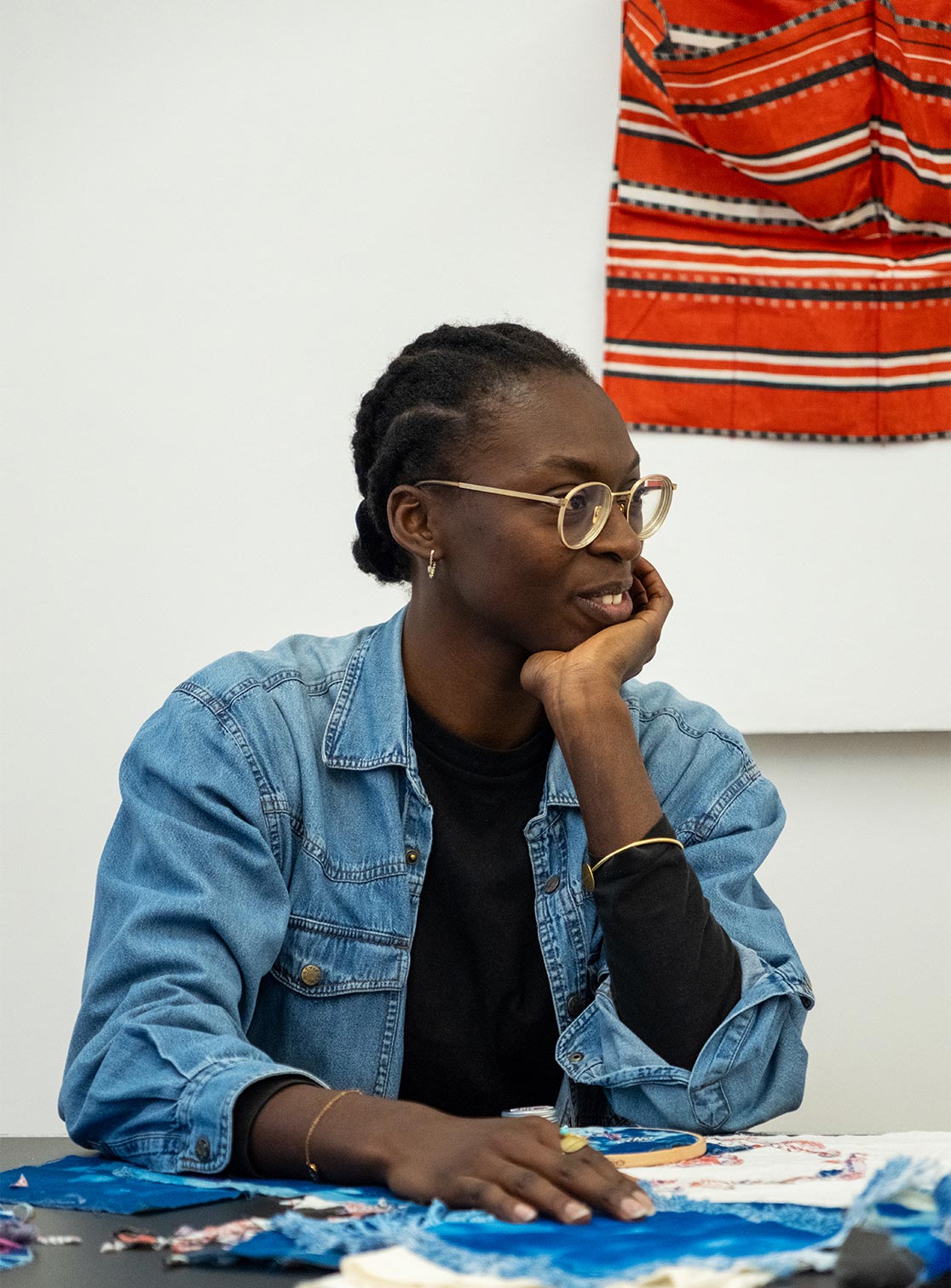
Austrian-Nigerian artist Abiona Esther Ojo combines autobiographical themes with photographic, textile and conceptual processes in her work. In her artistic practice, she explores themes such as identity, inherited memory and intuitive knowledge. Her work moves between social, cultural, personal and collective history and reveals the complexity of the human experience.
How did you get into art?
It all started with a bag! I came to art through my childhood curiosity, because, as a child, I was always fascinated by what are known as ‘diaspora bags’ or ‘Ghana must go bags’, as they say in Nigeria. These are large, checkered plastic bags – makeshift suitcases for an entire life. My parents kept their photos in them. So, my story began with me searching these bags for their history.
Where did you grow up and where did you receive your education in art?
In the countryside in Upper Austria. Later I attended a two-year photography college in Vienna. After that, I applied to the Academy of Fine Arts and studied sculpture and spatial strategies with Monica Bonvicini, Stefanie Seibold and Iman Issa. When I think about it now, my parents' photos led me to art; it was probably my interest in research and documentation.
What did you gain from your time at the photography college?
At the photography college, I learned to create with light. It was there that I created my first work that allowed me to reflect on how I see myself as a young black woman in society. That is how I made my first black-and-white photo series about hair – which has always been an important topic for me.
That reminds me of the novel Americanah by Chimamanda Ngozi Adichie, which fascinatingly illuminates how the Nigerian protagonist deals with her hair. Could one say that you engage with the topic in a similarly artistic way?
At first I did not see it that way, but I have actually been dealing with my hair my whole life. I focused on it so much because it was often outsiders who were so overly interested in my hair. In both positive and negative ways. My first artistic works, which I mostly did for the annual exhibition at the academy, were also about personal and collective experiences on the subject of ‘Afro hair’. One year, I made a sculpture out of countless steel wool pads. The inspiration for this sculpture came from a personal experience, but it was only set in motion when I read Maya Angelou's book I Know Why the Caged Bird Sings. In one situation, Maya Angelou describes how her frizzy hair is compared to black steel wool – an experience that shaped her early awareness of racialised beauty standards. With this work, I reclaimed my dignity. In that sense, it was a long-standing idea, an inner urge to finally deal with this topic for my diploma thesis, and to take more time for it. My aim was to take this preoccupation to a more profound, artistic level.
The magic is in every strand, the title of your ‘hair sculptures’, was your final project at the academy?
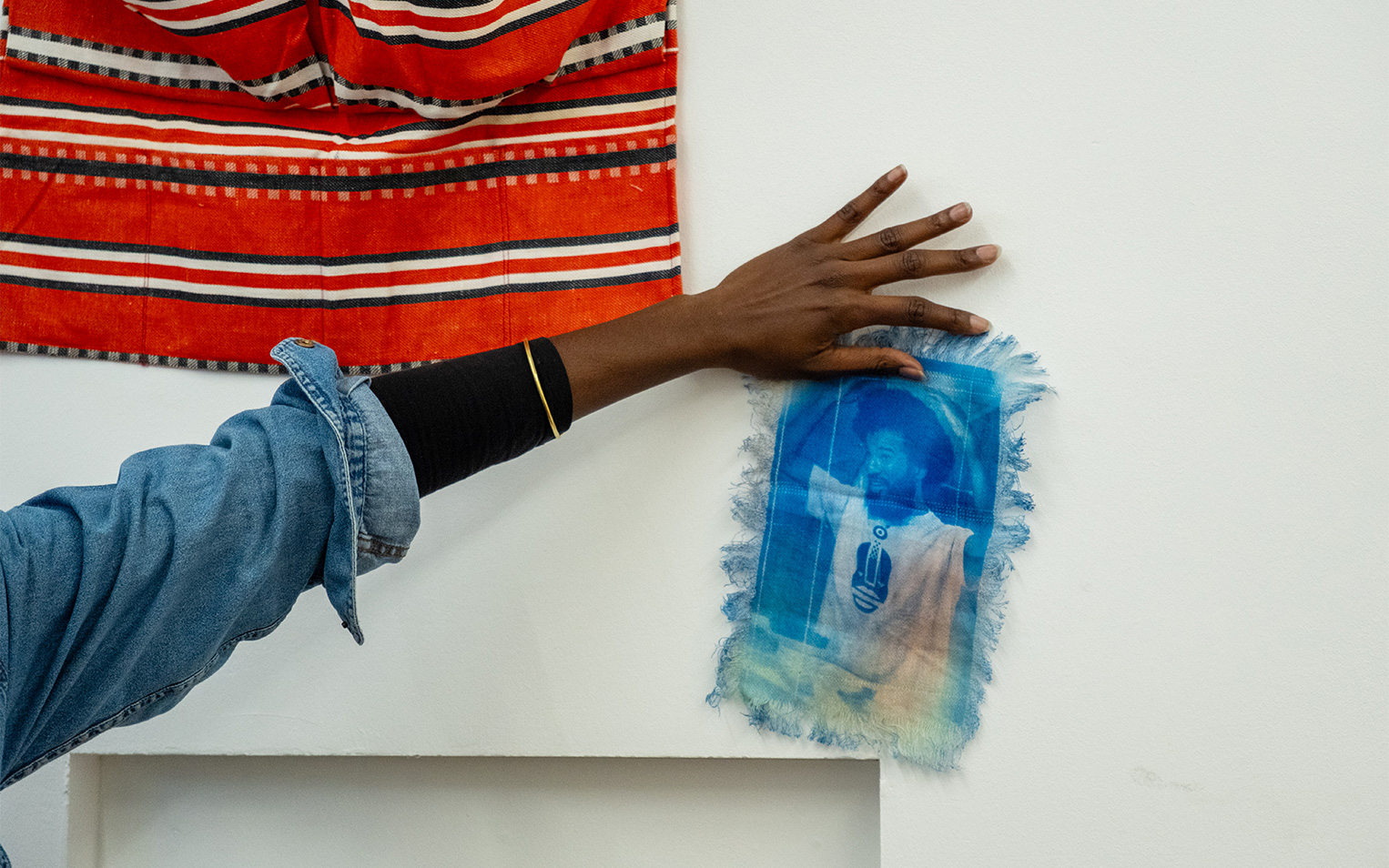
Yes, exactly, I produced a series of textile soft sculptures for my diploma exhibition. My work explored the social and political significance of Afro-diasporic hair and hairstyles – not only as an aesthetic feature, but as a cultural, historical, and identity-forming phenomenon. To do this, I worked with the photo printing technique cyanotype, also known as blueprinting, a photographic printing process that produces images in a characteristic blue colour. I took all the photos for my thesis myself and printed them with artificial and real sunlight onto various fabrics, which thus became ‘magical strands’ and from which I then formed ‘hair sculptures’.
What did you want to express with your work?
My work is very multi-layered. On the one hand, I wanted to depict the many processes involved in making hair. On the other hand, I was also very keen to show that ‘Afro-diasporic hair’ is not just an external feature, but a carrier of knowledge, history, identity, and resistance. With my work, I have condensed and at the same time unravelled many events. Essentially, my work is a tribute and homage to Afro-diasporic hair culture.
You gave the sculptures the form of hairstyles: braids, twists, curls... What were they filled with?
With love, tears and sweat (laughs)! But also with filling cotton and aluminium wire.
For this, you received the Kunsthalle Wien Prize 2020 and also the Academy's Award of Recognition in the same year. Where are the sculptures now?
The City of Vienna purchased one of the sculptures; the others are still with me. Some were exhibited in the Austrian pavilion at EXPO Dubai 2021.
Coming back to hair: what is so special about it for you? Did it make you feel different?
My hair has never been just an aesthetic feature for me. It is always also a sign of visibility – something that marks me as different in certain contexts.
Did you experience that strongly?
Racism remains embedded in our social structures, even though many people try to act in an anti-racist manner. I find it difficult to answer whether I have “experienced this strongly” because, for me, it is less about individual experience. It is more of a continuous awareness that shapes my everyday life and my thinking.
Is the common thread in your work related to this?
I often start my work with personal experiences, but it never remains solely about myself. Only gradually did I realise that my experiences tell not only my story, but act as a starting point for exploring themes such as family, diaspora and collective memory.
Do you think your work will be similarly driven or oriented in the future?
My work will continue to have personal impulses in the future, but it doesn’t always start with me. For my work Water We Doing, I was invited to do a solo exhibition at the MZ Balthazar Laboratory. There I came across an episode from Professor Balthazar – Amadeus, a character who has the ability to localise water. I interpreted this ability as follows: he hears the water – a subtle, intuitive perception of the flow and vitality of life. Interestingly, a similar ability also exists in reality: women in the Sahel intuitively sense hidden water sources, as I read in Lynne Twist's Soul of Money. This gave rise to my work, in which intuition, life energy and perception become visible. I always see myself as the starting point.
What is your working process like?
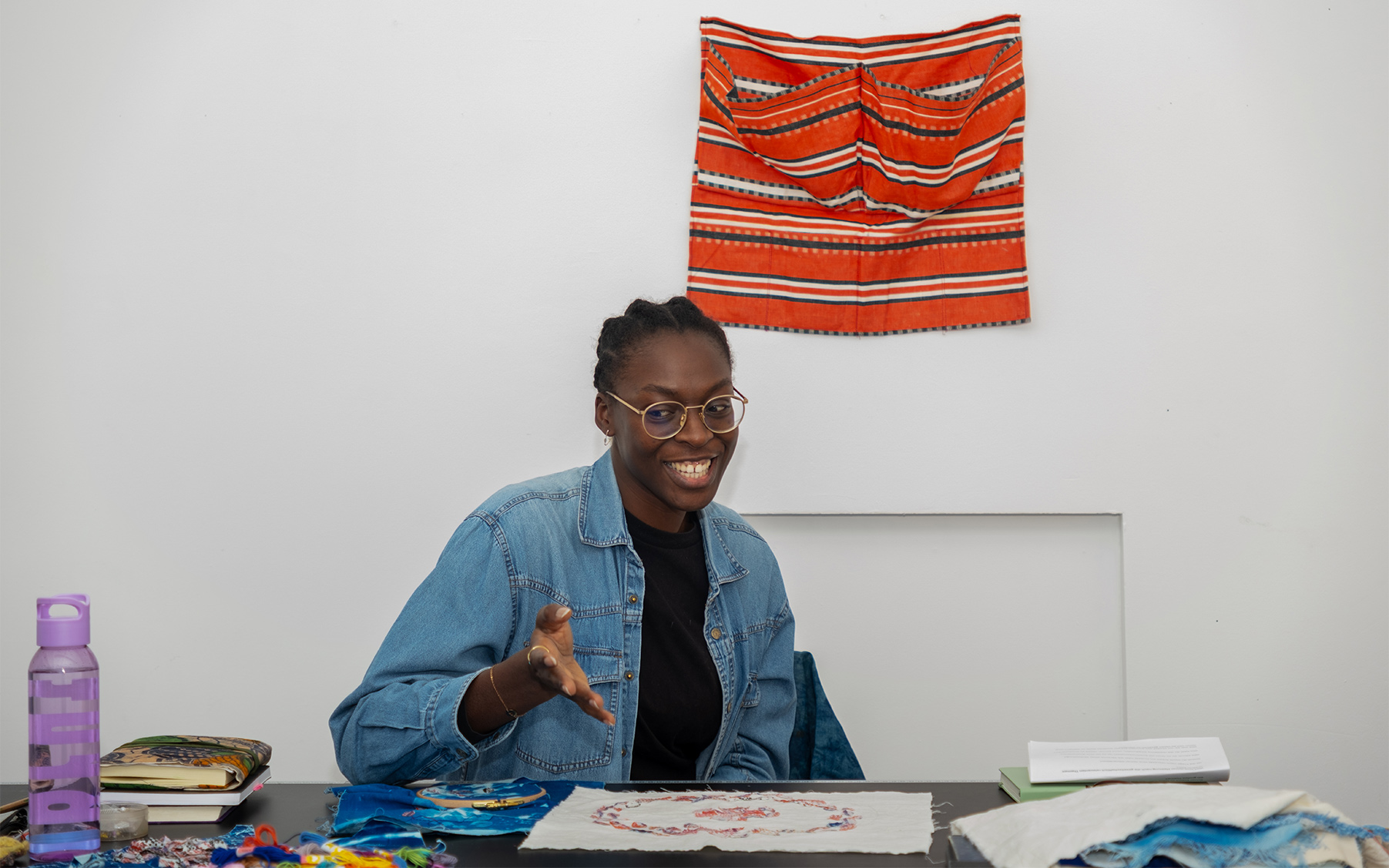
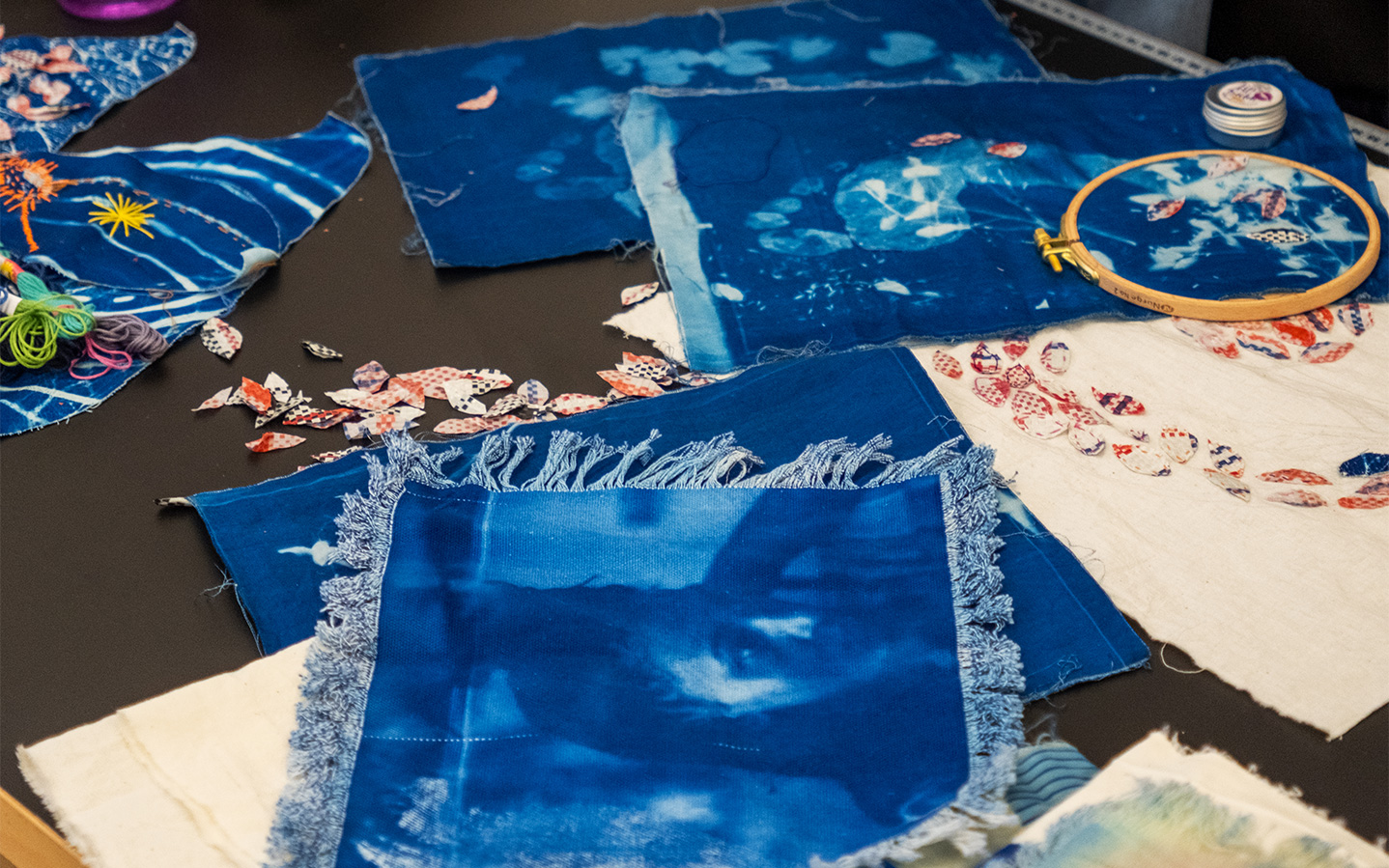
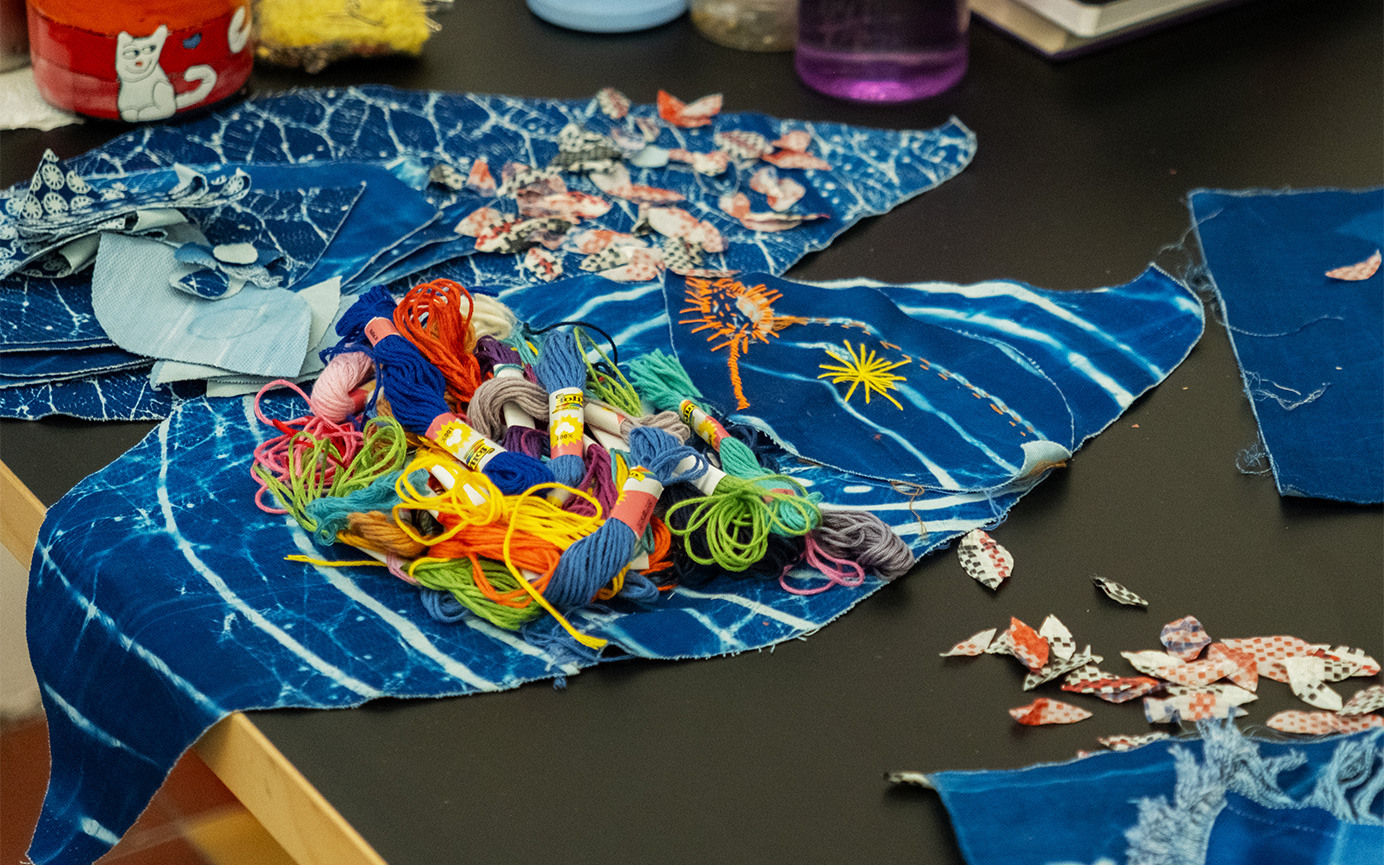
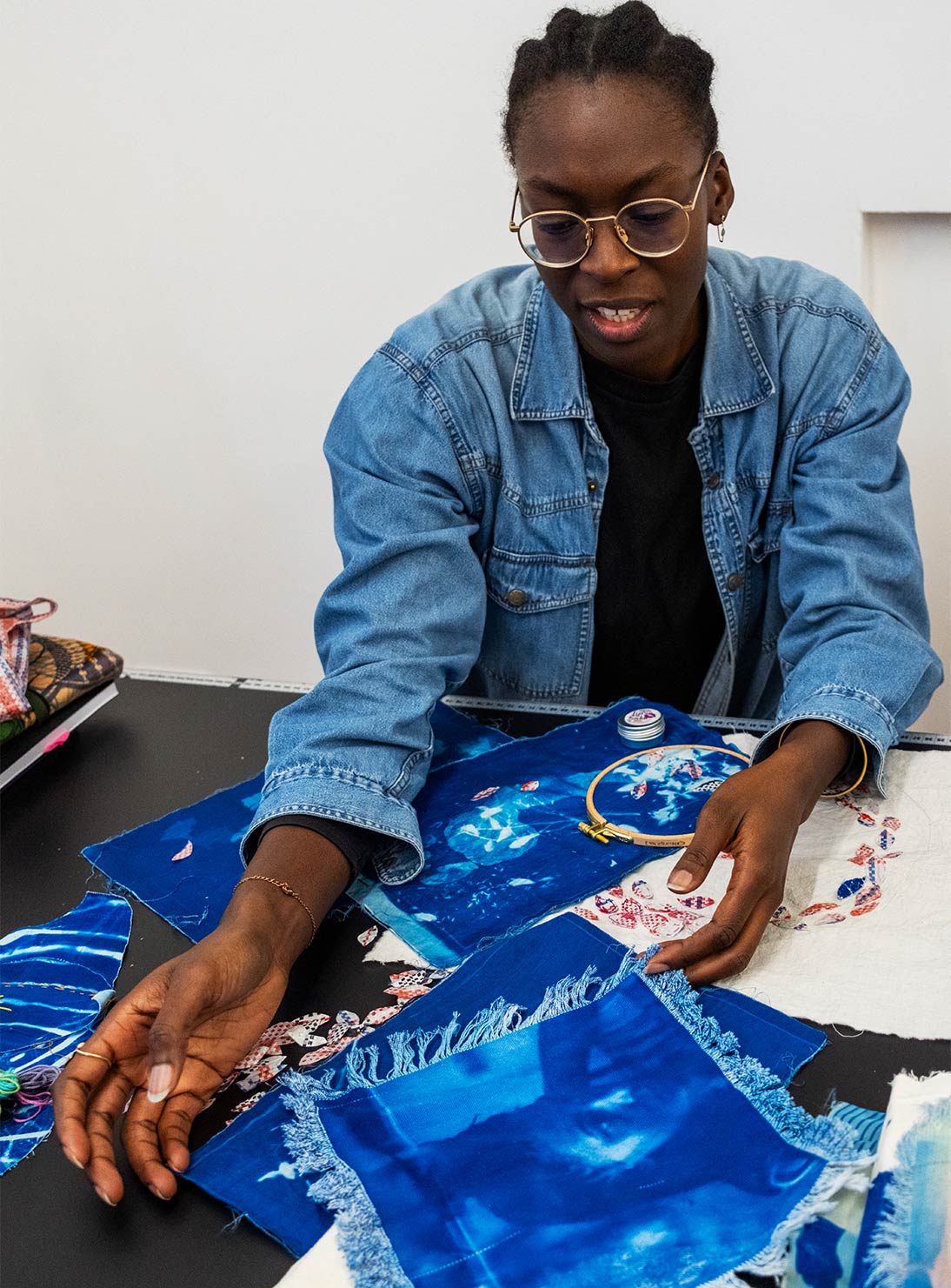
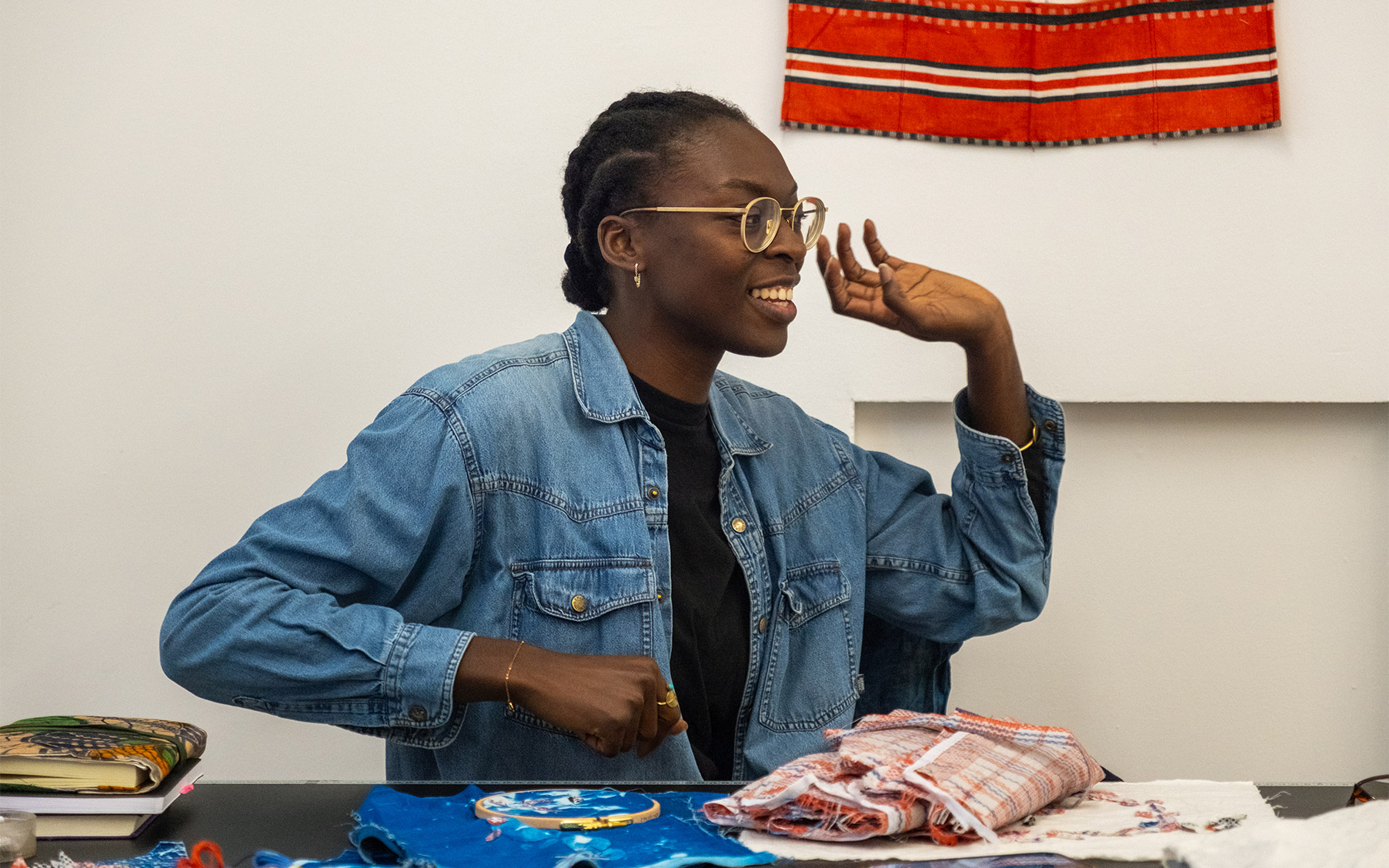
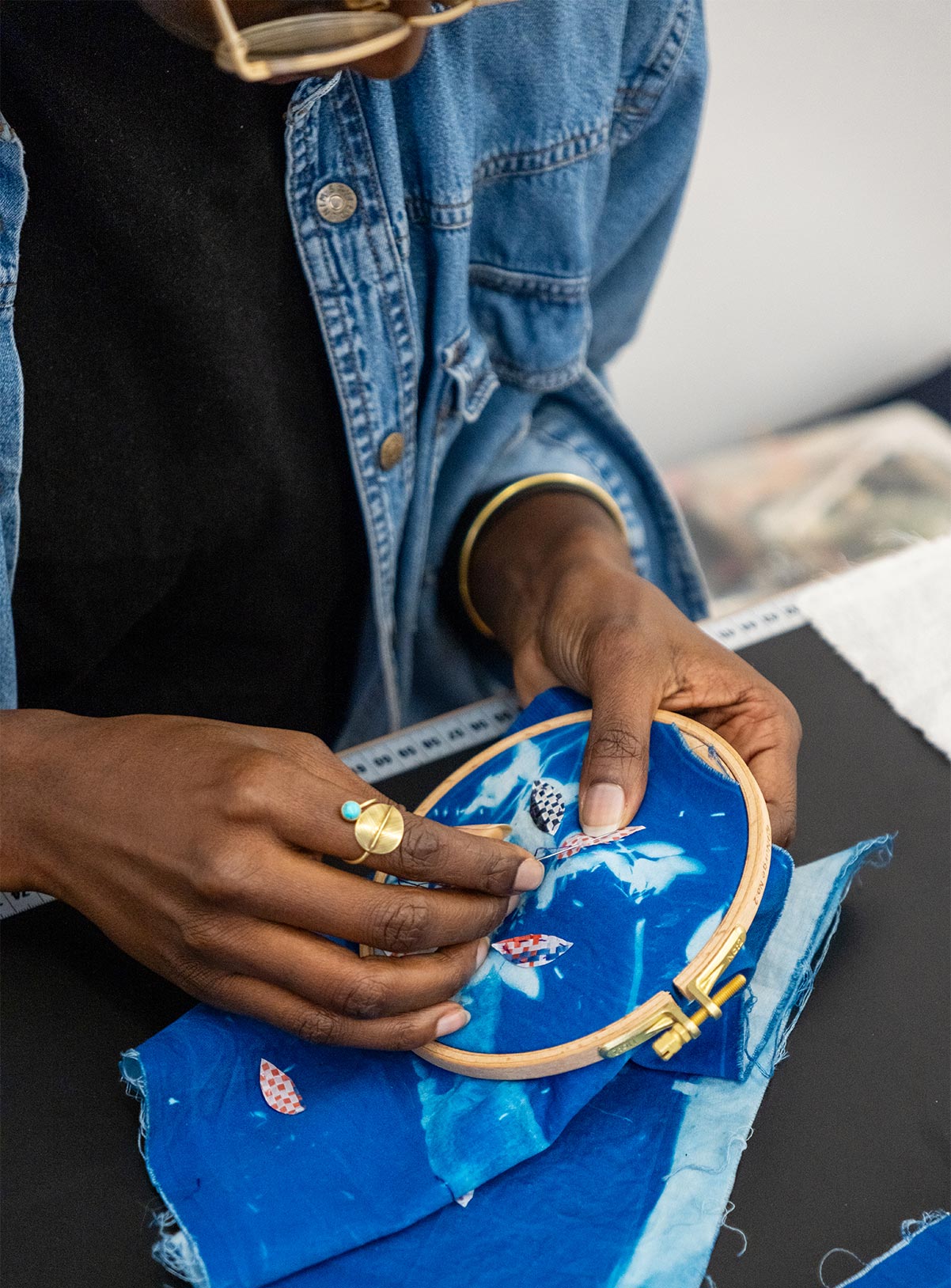
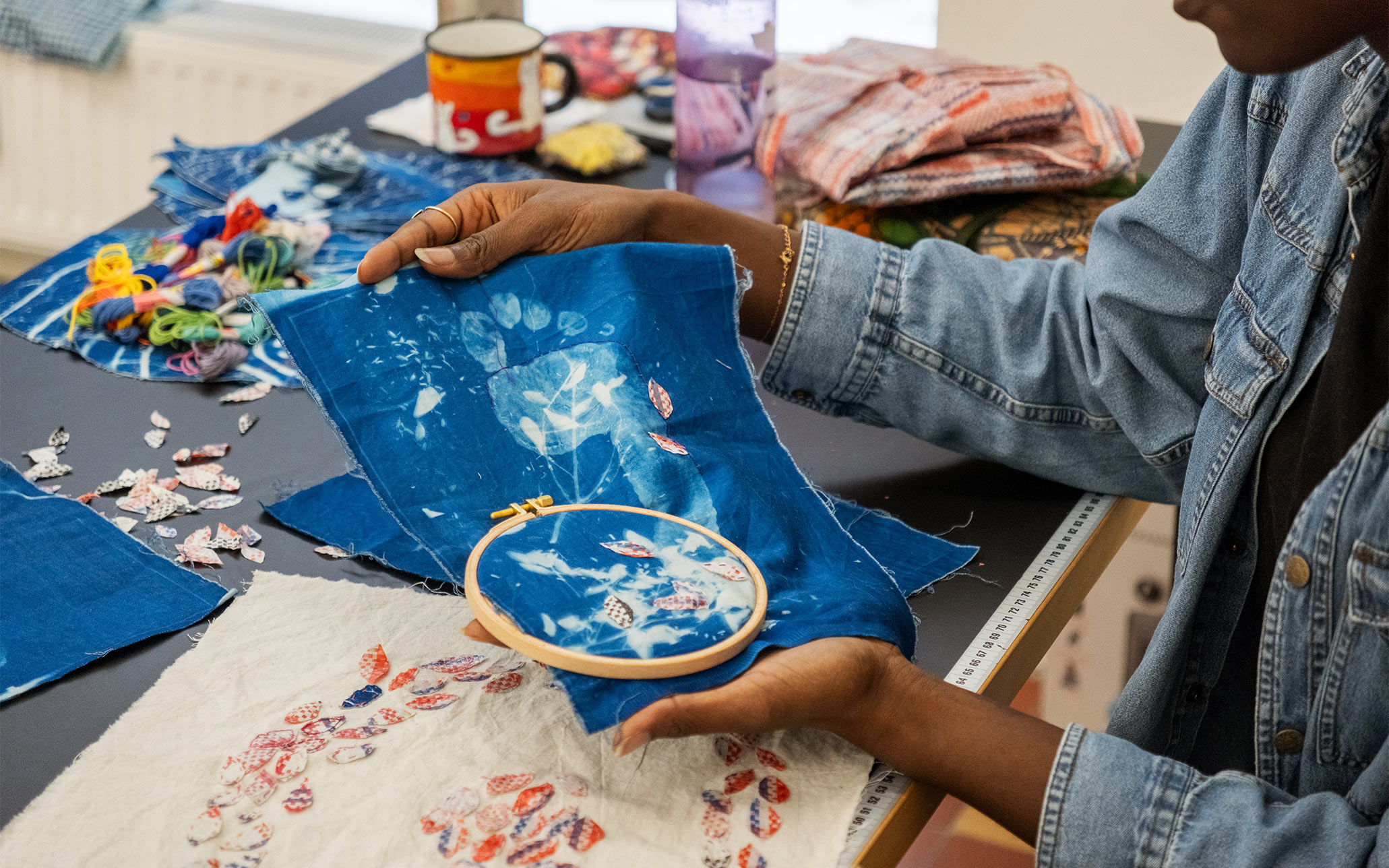
The plan sometimes only comes once I’m already in the process of making. I have a few tools and techniques that I work with, and then the idea emerges. It’s a fluid transition. At the moment, I’m embroidering cyanotypes of the imprint of my soles with colorful threads and “ghana-must-go” cut-outs. I don’t always know what I’m doing, but immersing myself in this meditative state brings the ideas to the surface.
Is art a path for you?
At the moment, yes. Art has been with me for a very long time, and through it I have got to know myself and my surrounding environment even more. It is a journey that never ends, but goes deeper. Even as a child, I was often asked where I ‘really’ come from. That question was likely the real trigger for me to ask myself at some point: where do I come from?
So you travelled to Nigeria?
Yes, and after my first trip to Nigeria, I was able to answer it better. There is a saying: ‘you do not know where you are going if you do not know where you come from’.
Would you agree with that?
Yes. My search goes in many directions. I visited my family in Nigeria, but that is not the answer to the question of where I come from. The answer goes much deeper than that. That's why I am very busy turning my attention to spiritual questions. Where do I come from as Esther? What is this inner source within me that lets me wake up every day?
Is art the means for you to arrive at this answer?
It is one of many means. But also knowing that I will never find a definitive answer. In English, there is the word ‘memory’, which expresses more than its German counterpart ‘Erinnerung’. It refers to the membrane, to the fact that knowledge lives in the body, and that this knowledge can often only be discovered when you go to certain places. And in all my search for ‘the’ answer, it is just as important to remind myself, again and again, that I know nothing.
An interesting point: as a young artist, do you have to address socio-politically relevant issues? Is there pressure to do so?
I am always reminded of Nina Simone, who said: “An artist's duty, as far as I'm concerned, is to reflect the times.” Yes, there is a certain pressure to create art that deals with our times. For me, however, this means above all turning to the issues that really move me. But it also requires a certain lightness, otherwise it becomes too intellectual.
Do you feel that you have to explain your art?
To a certain extent, yes. For a long time, I spent a lot of energy explaining myself or my experiences – and that becomes quite exhausting. Now I try to do that less, and focus more on my process and on creating space for inspiration. I am constantly inspired by others who in turn have been inspired.
Standing on the shoulders of giants?
That's right!
Speaking of inspiration, have there been any other special moments with artists?
Yes, wonderful moments! For example, with Janine Jembere for her series Channeling (Vienna) at the MUMOK for the exhibition Avant-Garde and Liberation. The photo series shows artist friends with their eyes closed as we ‘channel’ historical figures from liberation movements and performatively embody their thoughts and attitudes. I chose Faith Ringgold, who is a great role model.
She worked a lot with quilts...
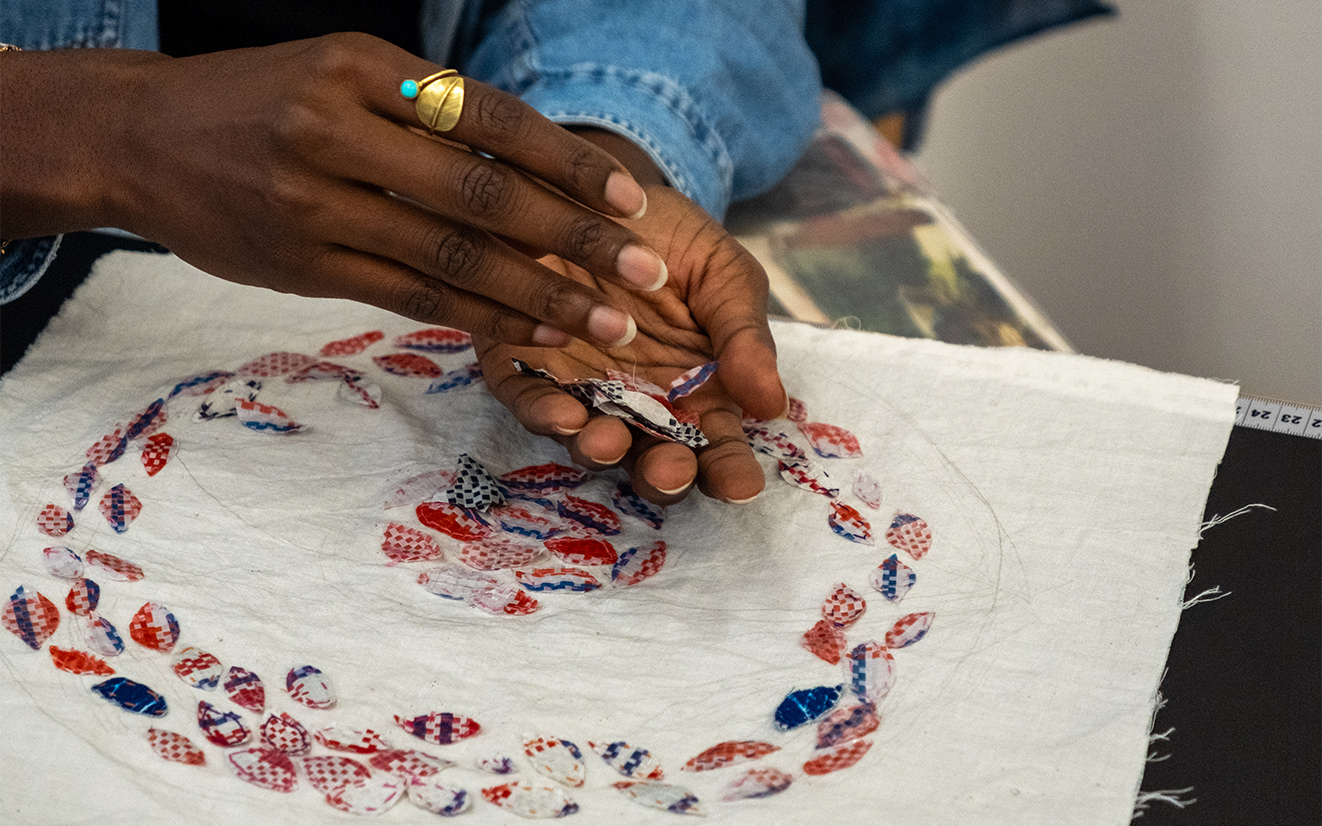
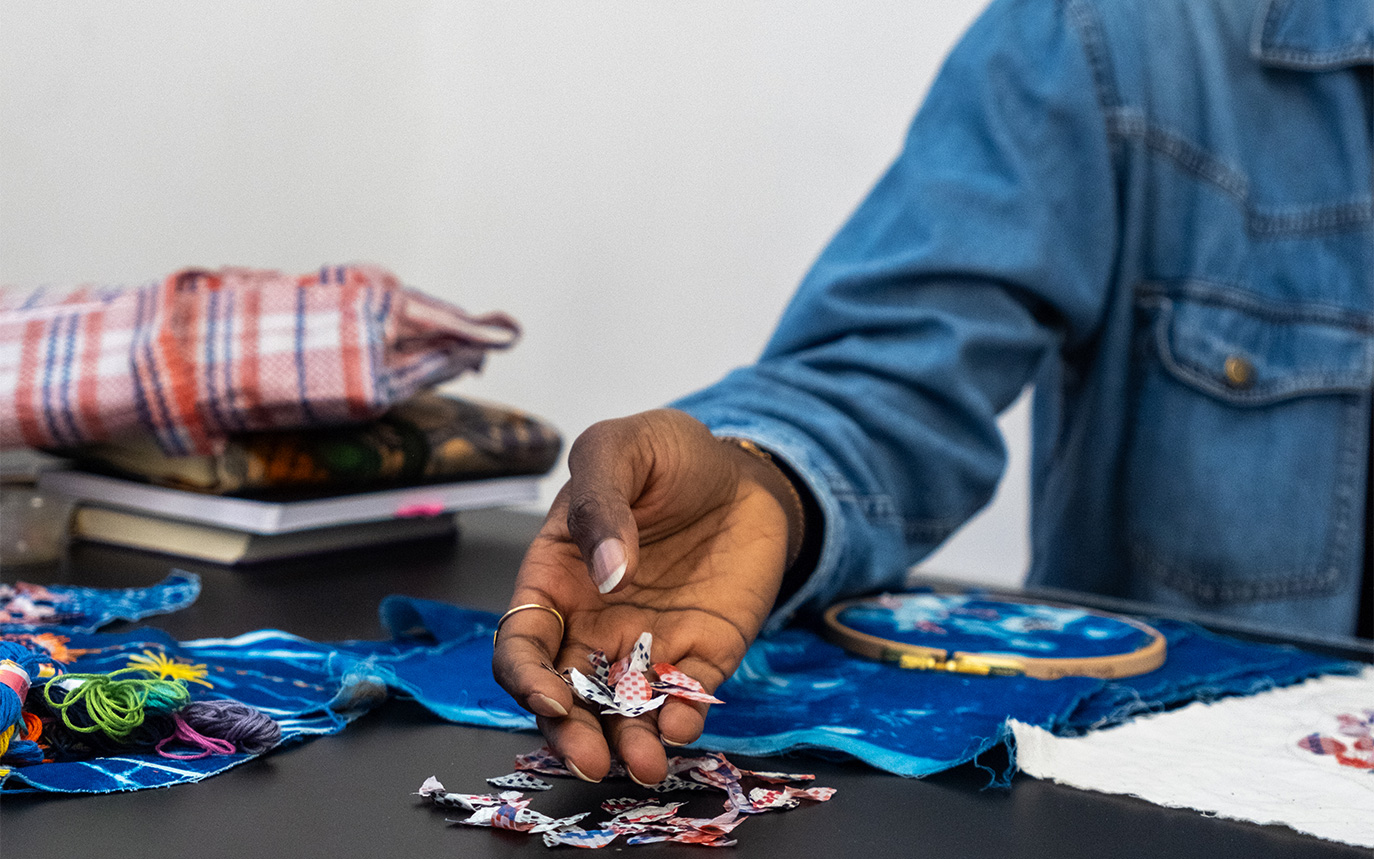
Exactly, that's what I am working on now! My new project is a quilt series made up of small pieces – which fits in well with the not-so-large space I am currently working in! To do this, I cut out many small shapes from the ‘diaspora bags’. These bags are associated with many things; anyone familiar with this material knows immediately what it is about. For example, what do you see when you look at this piece? (holds up a small piece of cut fabric)
A leaf? Or a flower?
For me, it's a pupil. But I like that everyone sees something different. It could be a leaf, but I also see a drop, a tear, an eye, depending on the context. I think it is beautiful to be able to represent a tear through the shape of an eye, the moment of letting go and starting over – it is a cycle with no beginning and no end.
We were just talking about how you’re currently working in a small space. How do you find working in Vienna in general?
Yes, exactly, I am currently doing an artist residency in Vienna, but after that I'll be working from home again, which is much smaller. Vienna is a good base for me because I have my family, friends and colleagues here. But I also try to get out of Vienna as often as possible, whether through collaborative projects or residencies. And that is exceptionally good for me, to escape my own bubble every now and then to ‘stay sane’.
Text: Alexandra Markl
Photos: Maximilian Pramatarov