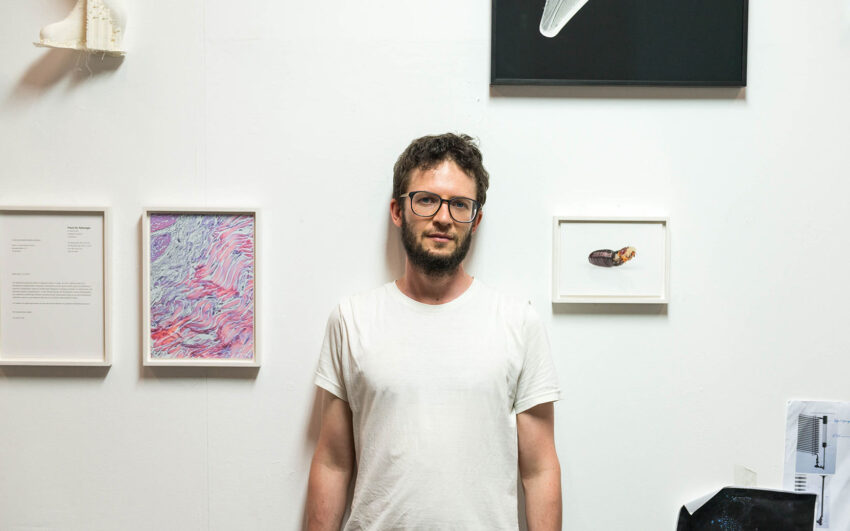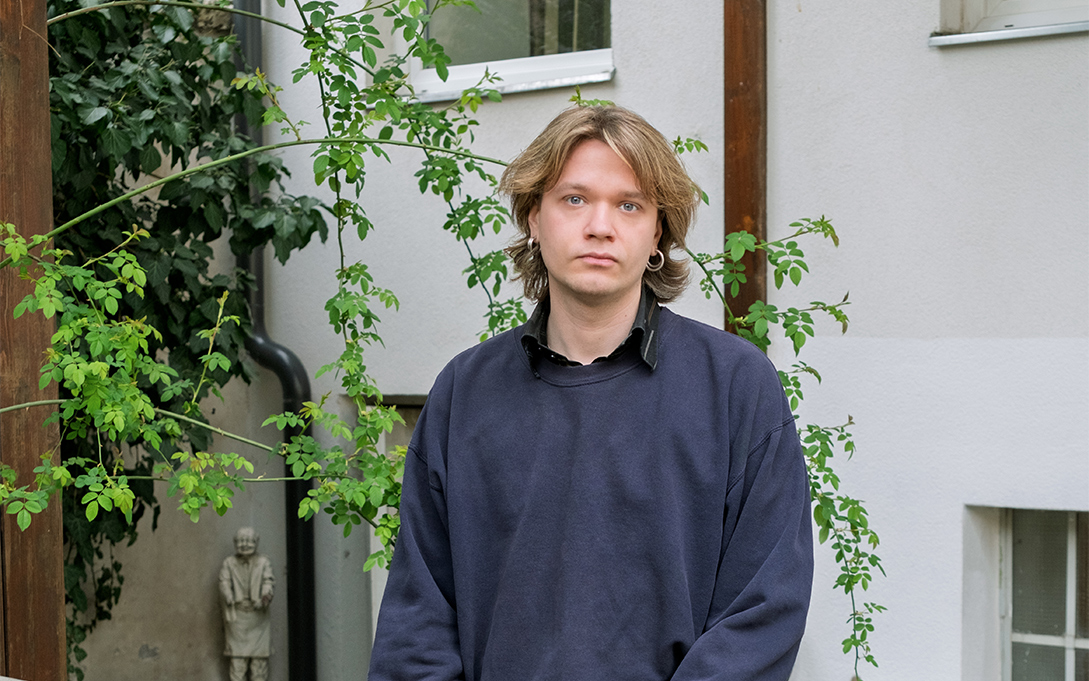
The Austrian artist Tobias Izsó works in the space between image and object. His practice takes its starting point from photography – not as a medium, but as a way of thinking, as a play with framing. From this vantage point, works emerge that unfold between assemblage and sculpture. At their centre are familiar forms – furniture, clothing, everyday objects – that function as cultural carriers. Wood, for instance, meets him as a kind of living resistance: a material with a will of its own, which he guides into a new, directed organicism through bending and sanding.
Tobias, how did you come to art?
Well, to be honest, I wasn't particularly good at school, and at the same time I come from a family where virtually everyone studied medicine – I was the only one who realised I had no talent for it whatsoever. My mother, however, is very creative, and that shaped me early on. I went to the Graphische (a vocational school for graphic arts and design in Vienna) and studied graphic design, but I could never really identify with it. There was a photo studio there, though, and through that I got into photography very quickly. I then applied to the Angewandte (University of Applied Arts Vienna) and was accepted into Gabriele Rothemann's photography class. In hindsight I'd say I was probably still a bit too young to understand that photography wasn't quite my thing either – but through it I had the next infrastructure.
When did the moment come when you realised that working with materials interested you more than the pure image?
That was actually quite early on in my studies. In our first semester, building frames was compulsory. That's how I came to wood. From there, one thing led to another: I started building props for my photographs – objects I'd then use in the image – and quickly moved into assemblage, which is still where I feel at home. But in that sense I never really had a discourse with sculpture, and I still think quite pictorially.
You say you grew up in a creative environment. What shaped you most within it, and what of that can still be recognised in your work today?
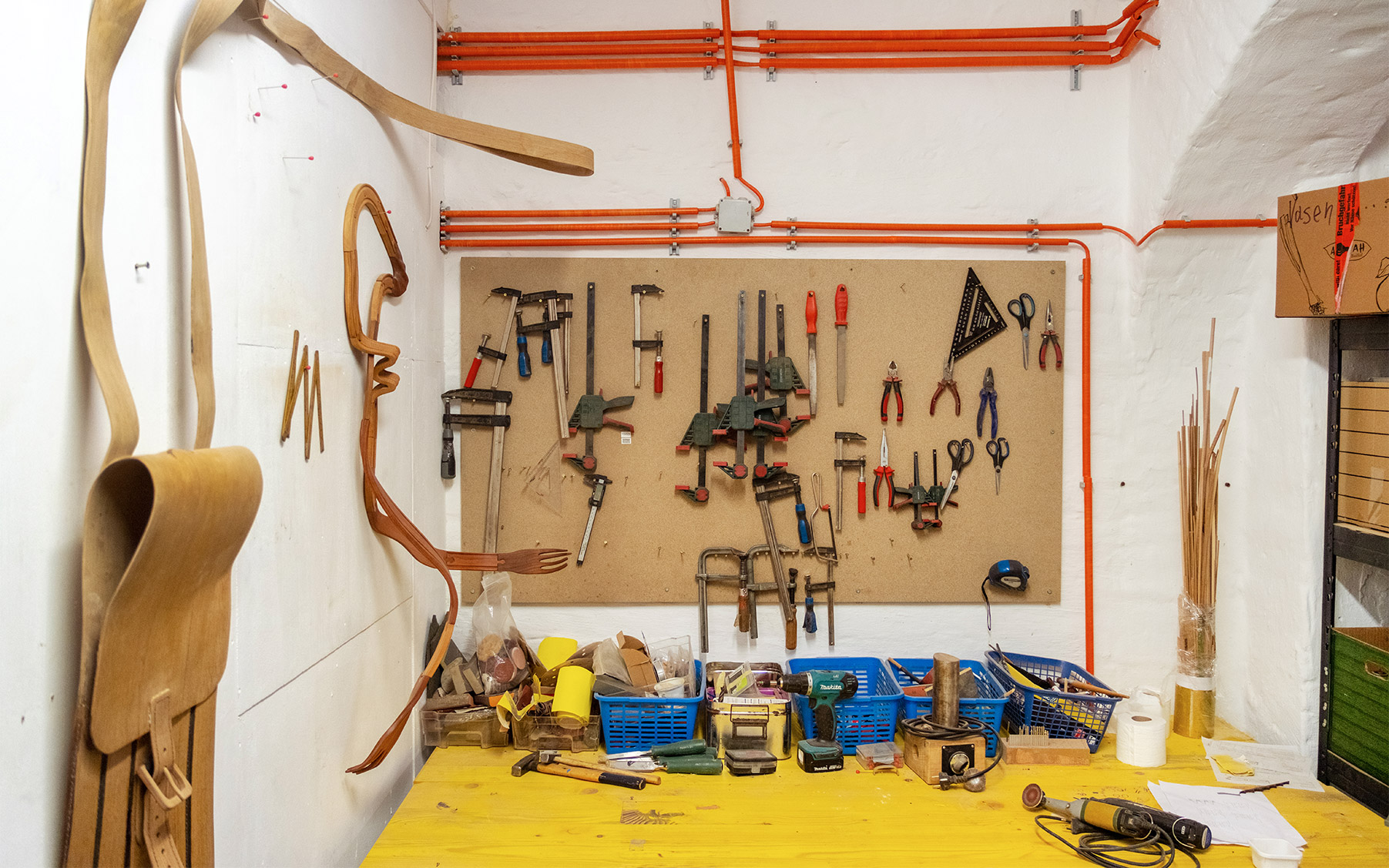
My mother was a goldsmith and a crafting queen, and the idea that you can just tinker your way through anything yourself is something I learnt from her. Or, more precisely: that you can teach yourself techniques. I learnt very early on how to copy things without having the proper knowledge for it.
Just give it a go?
Yes, just give it a go – and then a lot of sanding.
How do you begin a new work? Do you start with an idea and then turn to the material, or the other way around?
Funnily enough, it's quite ambivalent. On the one hand, I have fairly clear images in my mind that I then try to realise – but I'm currently working mainly with wood, and that has quite a life of its own. You very often have to make compromises, or it's only during the process that you discover new possibilities, or indeed impossibilities. It also depends on the project, how I work. Sometimes it's quite linear, with a sketch; other times it's more a matter of trying and sensing.
What role does craft play in your art?
It plays a very significant role in my art, because I work through themes by way of craft. I acquire techniques in order to quote certain things – not out of nostalgia, but rather from an understanding of how something is built, how a structure works. I'm interested in how you can reproduce it, how you can appropriate it, so as to use it for yourself or to confer new connotations onto it. I also genuinely love craft. I think the moments in the process are the things that give me the most pleasure – less the exhibiting itself, and more the trying, and also the failing (laughs). I also find it wonderful that platforms like Instagram mean you're not just served random content, but that you also see a lot of DIY projects. So I try to pick things up in a layman's way through Instagram or YouTube – and quite often it works.
What fascinates you about working with wood?
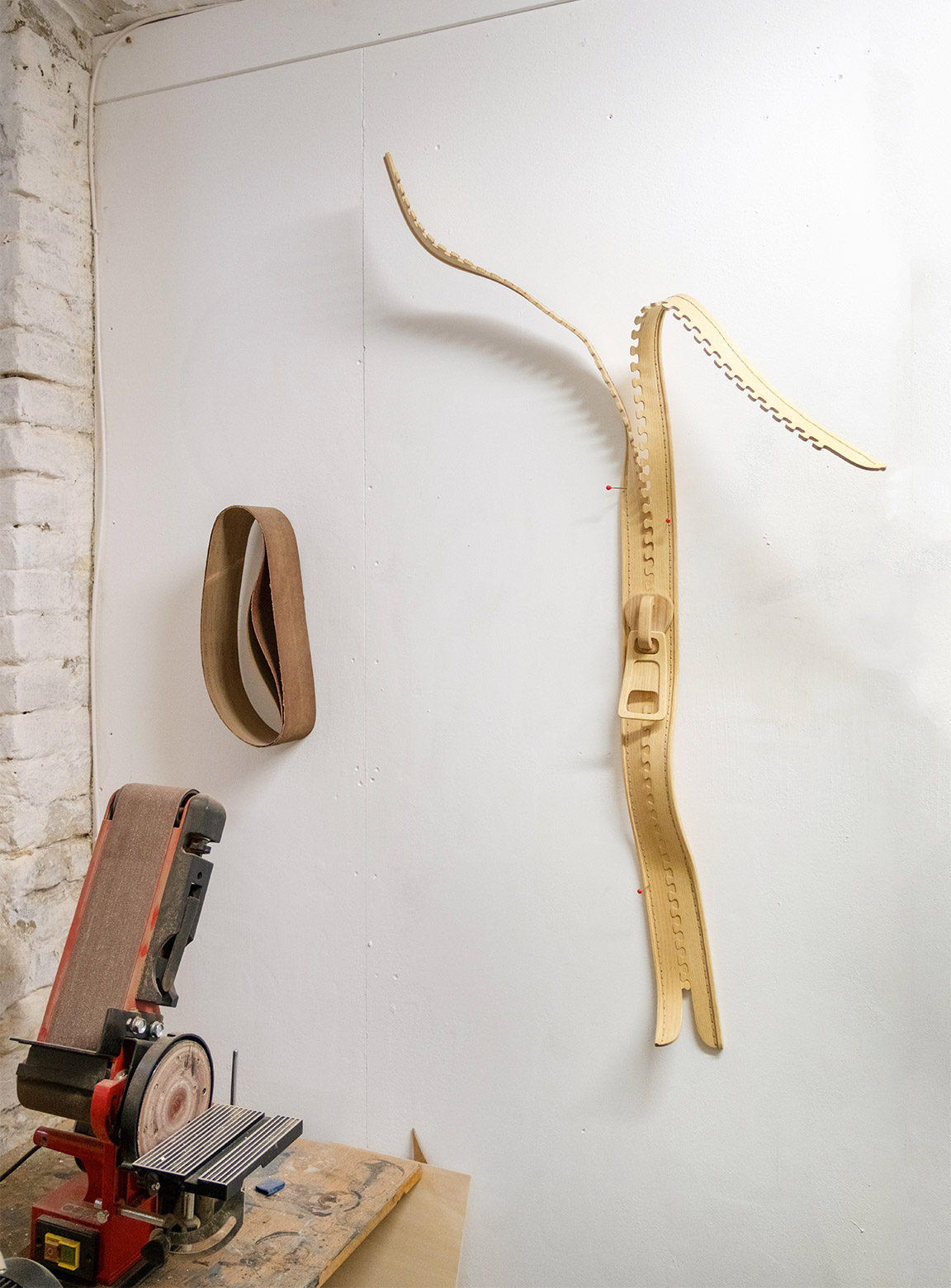
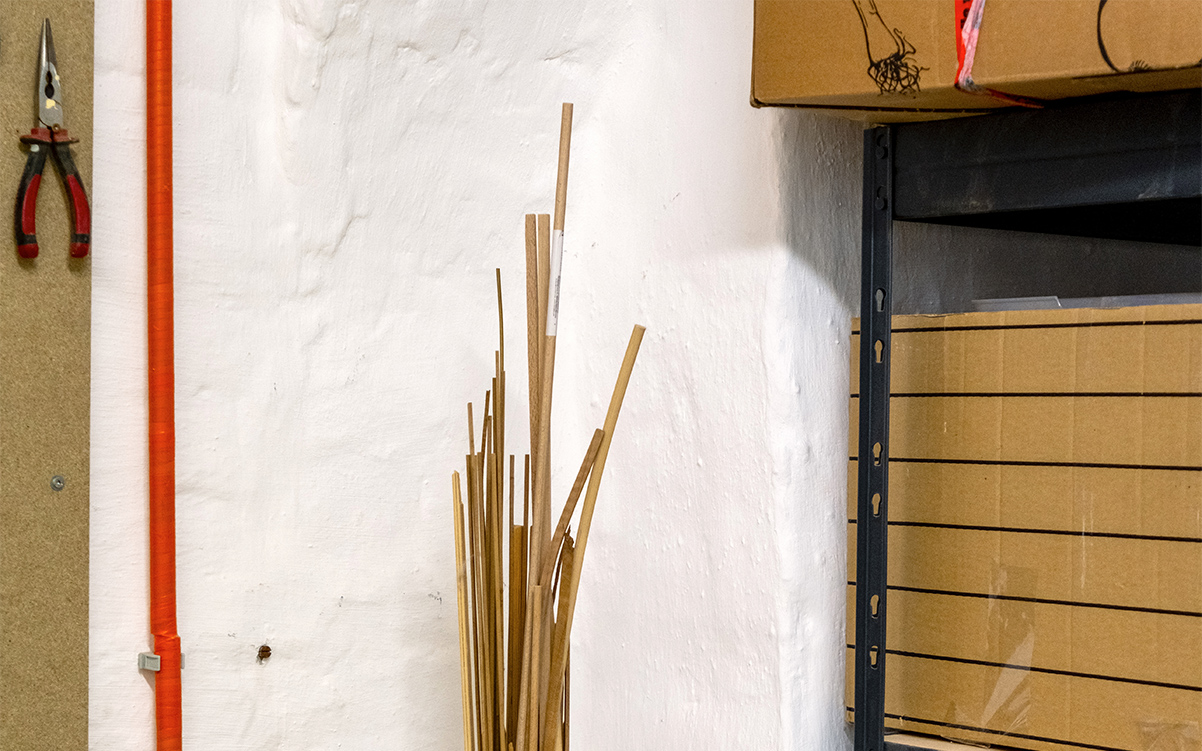
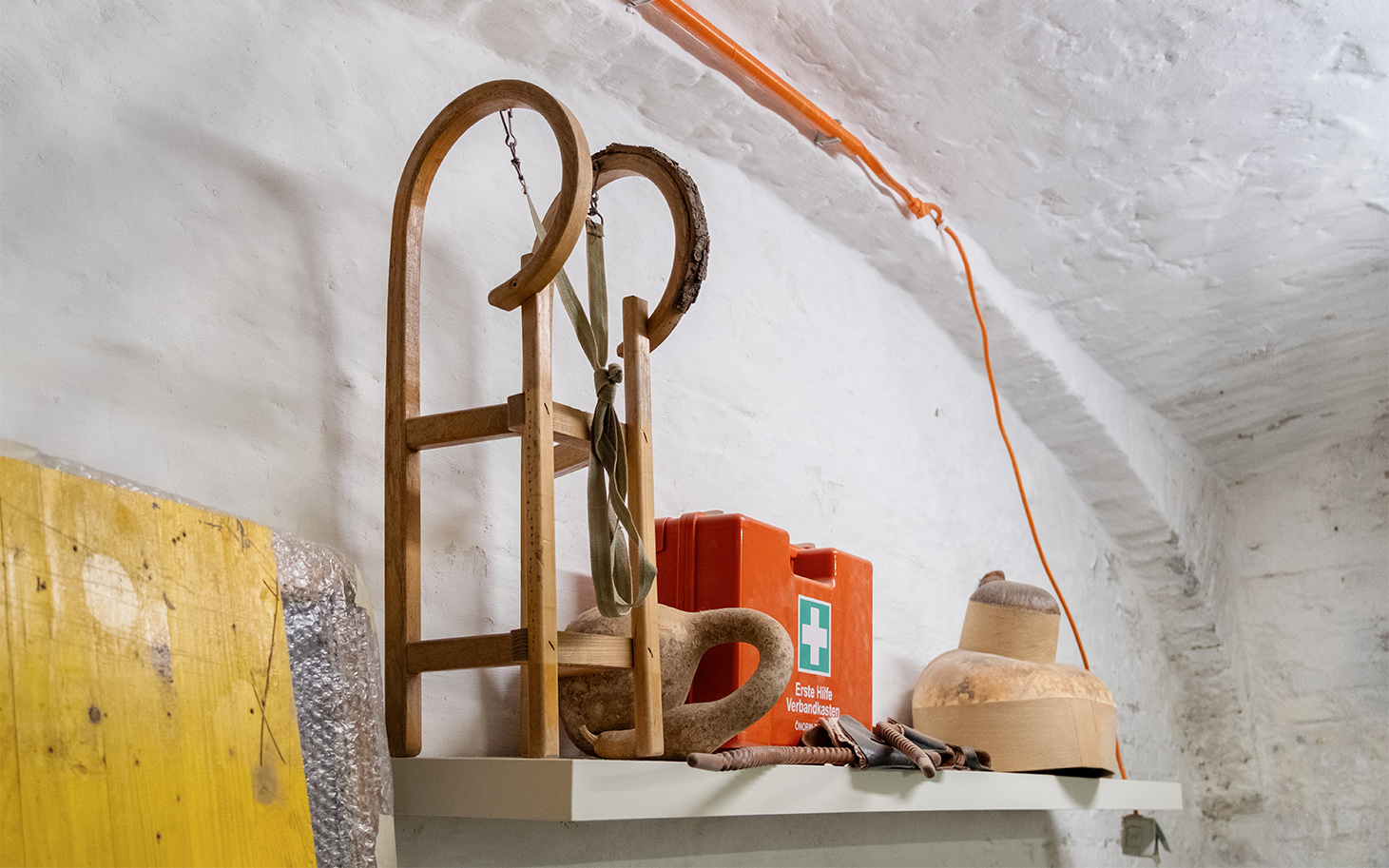
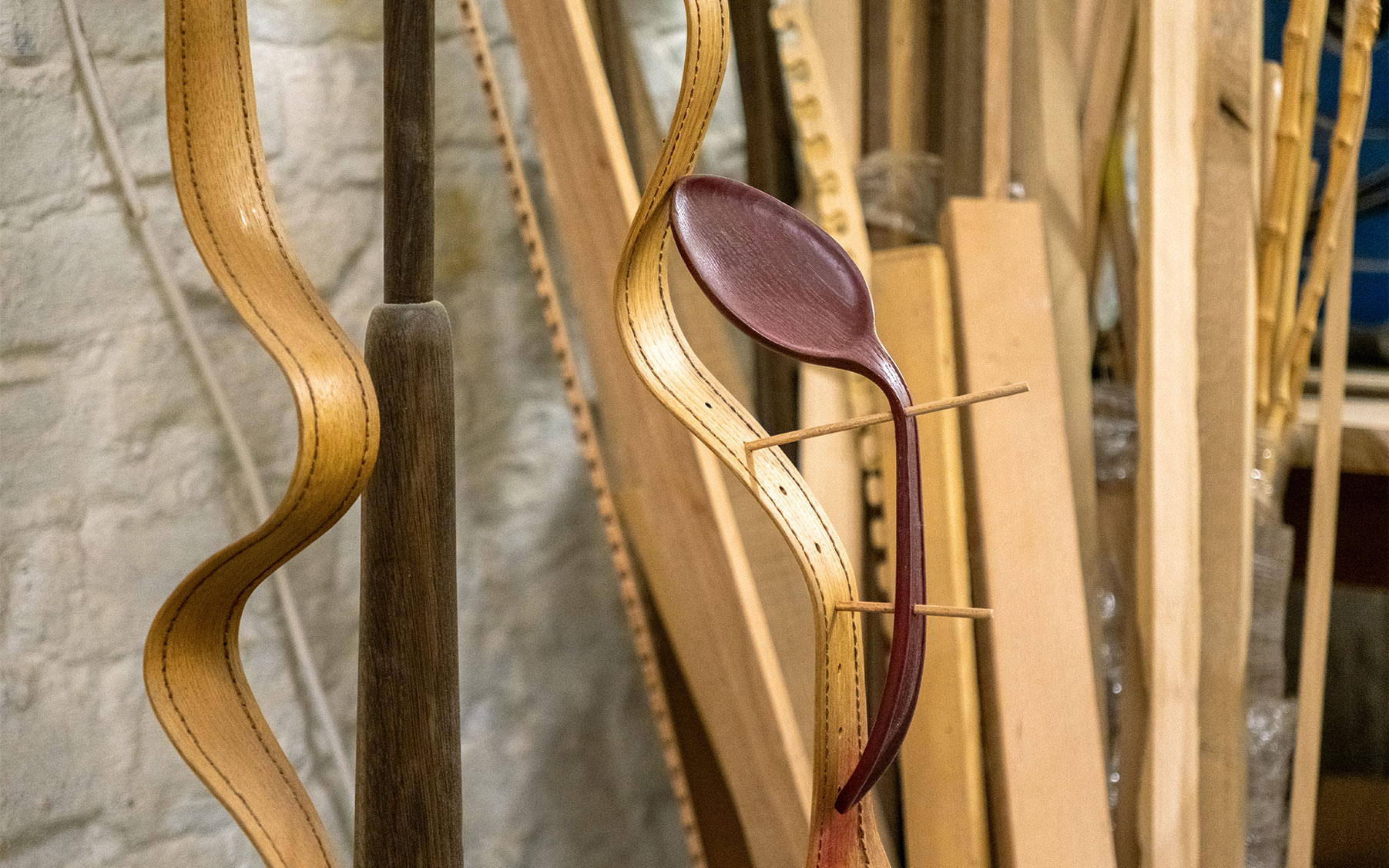
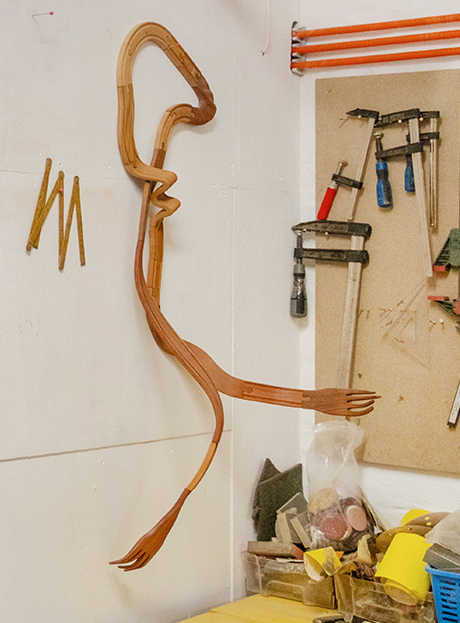
I have little connection to nature – trees, to me, have always just been rectangular pieces of lumber. I find the process of taking that piece and leading it back into an organic form directed by human hands absolutely fascinating. The techniques I work with come from furniture-making – or more precisely from instrument-making. I work here, for example, with a hot iron, or with steam for larger pieces, to bend the wood. In the end, though, the iron is really just a clothes iron with a different shape (laughs). Clamping and sanding are the main things I'm doing right now.
What motifs do you enjoy working with?
The outcome is usually assemblage or sculpture. I work a lot with wood because in cultural history it carries a clear significance tied to home, furniture, and bourgeois domesticity. That's also an attribution I try to play with. Generally, it's themes of domesticity that occupy me – but also clothing. There I'm thinking above all about systems of measurement and objects as cultural codes. Clothing is relevant to me because, in my view, it's a very apt and immediate lens through which to examine themes of class consciousness and belonging.
Where do you draw your inspiration from?
My inspiration comes from various sources, with Vienna of course playing an important role. I'm drawn above all to structures and codes that manifest themselves in everyday things – in the old-bourgeois or old-established, as found in café culture, for instance. At the same time, it's less about a specific place than about situations in which different systems, materials, or meanings converge and begin to react with one another.
What does a typical working day in the studio look like?
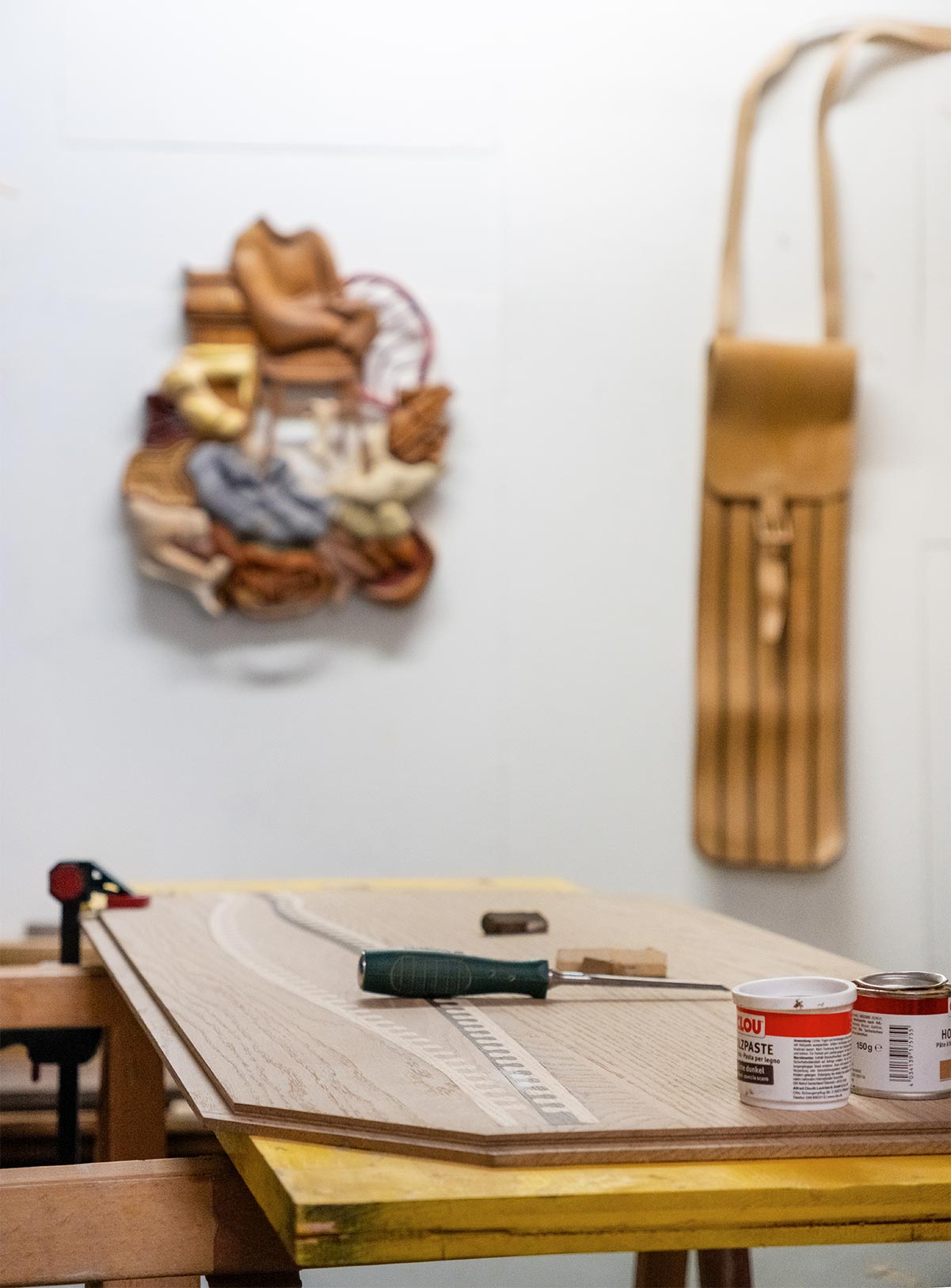
There isn't really a clear routine, but I usually start early and work my way through the day in a fairly continuous fashion. A lot happens in repetitions – adjusting, checking, reworking. A large part of the work is actually sanding: a pretty slow and physical process in which things only gradually come to a point.
How do you work with scale and dimension?
Funny question. I think my approach to scale comes strongly from photography. It's something I find very subjective, but it becomes particularly relevant for me when it creates a trompe-l'œil effect. That play with perception and illusion transfers directly to my thinking about scale. When something is large in the original – or is made larger – it can have a completely different impact and intensify that illusion further. So I often work at a 1:1 scale, or deliberately go into enlargement: a kind of zooming in on the object. Scale, then, is pretty central to what I do.
What significance does order have in your work?
I'm an extremely untidy person myself. It cost me a lot of time yesterday to make this space presentable (laughs). But it's true: I work serially. That is, I essentially don't make individual works. It's always several things that have a kind of polyphony, and that only create an ordering system in their togetherness, I think. One belongs to the other; one serves the other.
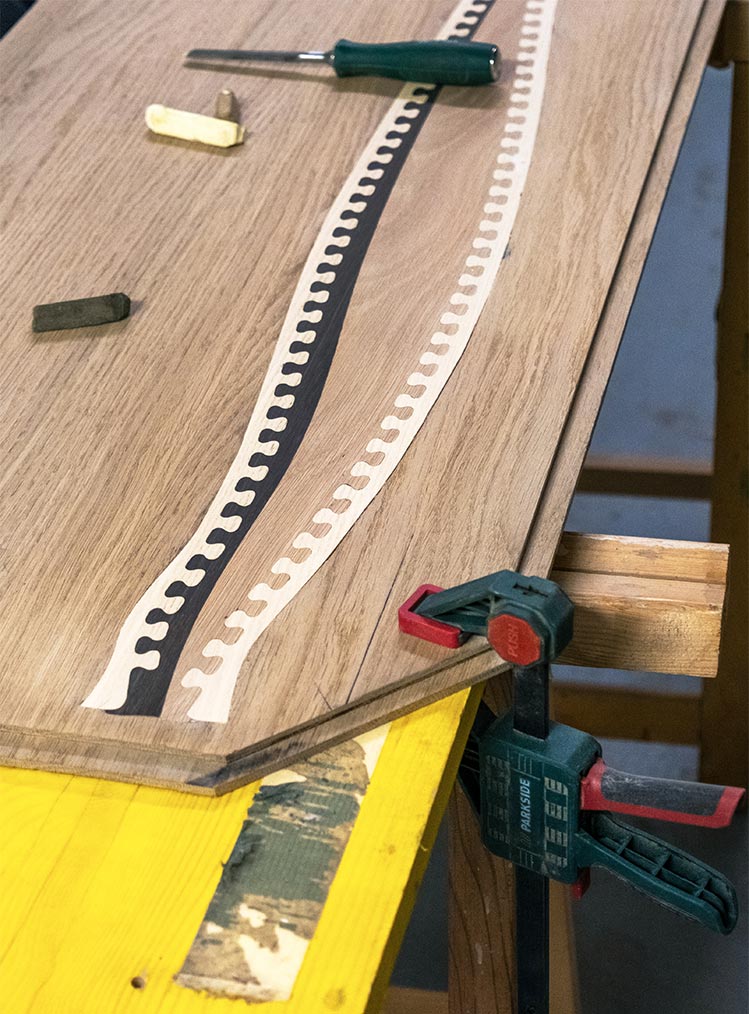
What has been preoccupying me for a while now are plug connections – this chaos that somehow comes together into one. By that I also mean the joining of different materials: upholstered elements, woven rattan, or carved ones. That's also why I'm so fond of plug connections – it's the coming-together of things that don't inherently belong together, but find their way to each other through a narrative.
What role does the theme of people and their possessions play in your work?
A fairly central one, I'd say. I mean, I am very figurative, but depicting a person – that doesn't really interest me. It's more the belongings of a particular group in society. Those are the things I'm concerned with. So the theme is, for me, always very body-related.
What interests you about the tension between the private and the public?
That the representation of things is so inherent: how we're dressed says a great deal about how we feel, or how we want to feel, but also about where we belong and which constraints we submit to.
Does your work change your perception of everyday objects?
Yes – I'm very interested in surfaces. I love touching things, especially anything soft and fluffy. But right now I'm looking very explicitly at shirt collars. I think when you engage with something, you start noticing it much more.
So when you walk down the street, you look at every shirt collar that comes your way?
Exactly!
Some of your works seem to take on a life of their own. Are there certain qualities you associate with them?
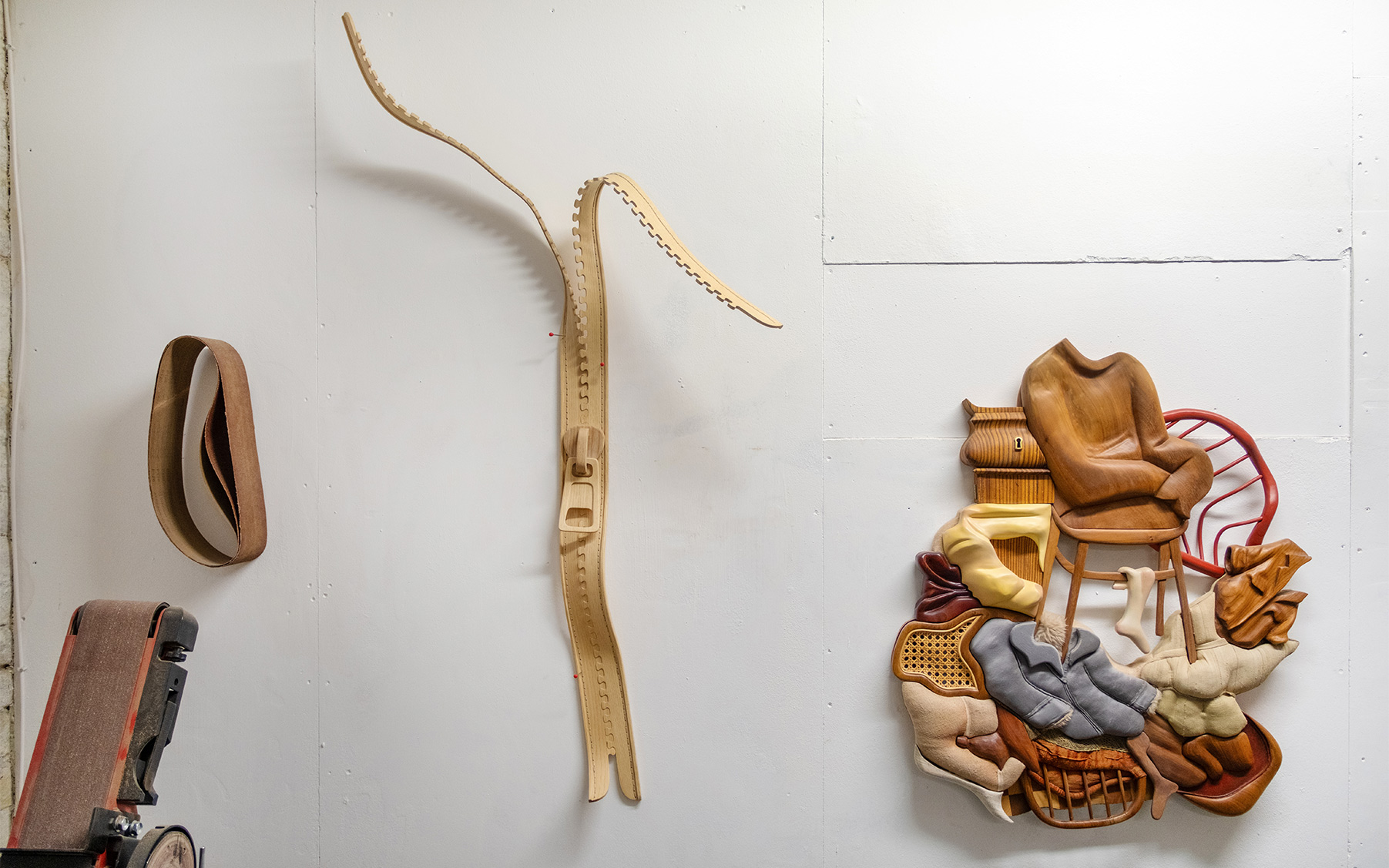
I think it comes from something very early in my childhood: I've always had a very strong relationship with interior spaces and have always been very fond of furniture. It's something deeply human, that meaning gets attributed to things. I find it fascinating to go beyond that phenomenon and then attribute something different to those things.
In your work, are objects really what they appear to be, or do they stand in for something else?
Both – but what matters most to me is above all the translation of something hard into something soft, or vice versa. I also frequently work with such juxtapositions and displacements. But sometimes it's also simply the thing that it is – with the cultural history that it already has, independent of me. But, as we've discussed: through the enlargement, through the zoom, it then also takes on a kind of heightening.
What are your new projects?
I always have the feeling that there's too much to do, but that's not getting any less. At the end of the year I have an exhibition at the Max-Pechstein-Museum, where I'd like to work extensively with umbrellas. What's clear is that I want to keep working with wood. But at some point I'd also genuinely love to come back to textile and upholstery work, because in a way that's simply faster – and not quite as dusty (laughs).
Text: Lara Kastler
Photo: Maximilian Pramatarov